Configuring the Discovery Plugin
The Discovery plugin retrieves its configuration from three sources, which are merged at request time: a global JCR node shared by all channels, optional per-channel overrides, and coded defaults for any unset values. Only three credential values are required for a functional installation; all other settings are optional.
ON THIS PAGE
- How resolution works
- The global configuration node
- Injecting credentials
- Environments and staging
- Per-channel overrides
- The product field list (fl)
- Sort options
- Picker field mapping
- Circuit breaker tuning
- Verifying configuration
How resolution works
Global JCR node            Per-channel hst:channelinfo
─────────────────────      ───────────────────────────
accountId                  discoveryAccountId (override)
domainKey                  discoveryDomainKey (override)
apiKey                     discoveryApiKeyEnvVar (override)
authKey                    discoveryAuthKeyEnvVar (override)
defaultFieldList     ←     discoveryDefaultFieldList (override)
defaultPageSize
defaultSort
sortOptions
environment
- Global node: Shared by all channels. Use this for deployment-wide settings such as credentials, the default field list, page size, and sort options.
- Per-channel overrides: Optional. Configure these on
hst:channelinfoif different channels require different Discovery accounts or catalog schemas. - At request time, the plugin uses the channel override if set; otherwise, it falls back to the global node value; if neither is set, the coded default applies.
Credential values (accountId, domainKey, apiKey, authKey, environment) are resolved in this order: environment variable → system property → JCR. This allows you to keep secrets out of JCR in production environments.
The global configuration node
The plugin reads configuration from a single, fixed JCR node:
/hippo:configuration/hippo:modules/brxm-discovery/hippo:moduleconfig/discoveryConfig
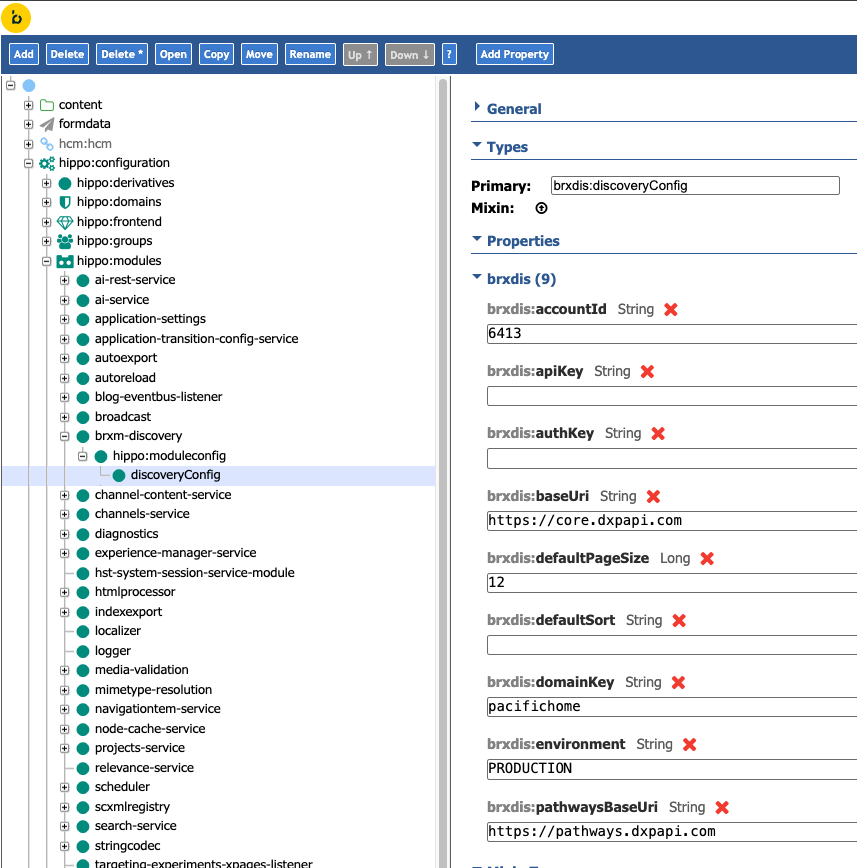
You can create this node using your project's bootstrap configuration:
definitions: config: /hippo:configuration/hippo:modules/brxm-discovery/hippo:moduleconfig/discoveryConfig: jcr:primaryType: brxdis:discoveryConfig brxdis:accountId: 'your-account-id' brxdis:domainKey: 'your-domain-key' brxdis:apiKey: '' brxdis:authKey: '' brxdis:environment: 'PRODUCTION' brxdis:defaultPageSize: 12 brxdis:defaultSort: ''
Only accountId, domainKey, and apiKey are required. Leave apiKey (and authKey, if used) blank in the JCR and inject them using environment variables. See Injecting credentials for details. The node itself is optional; if it does not exist, the plugin uses environment variables, system properties, and coded defaults for configuration.
Injecting credentials
For instructions on generating or rotating your API key and auth key, refer to the Discovery API Key Management documentation.
| Setting | Environment variable | System property | JCR property | Required |
|---|---|---|---|---|
| Account ID | BRXDIS_ACCOUNT_ID | brxdis.accountId | brxdis:accountId | Yes |
| Domain Key | BRXDIS_DOMAIN_KEY | brxdis.domainKey | brxdis:domainKey | Yes |
| API Key | BRXDIS_API_KEY | brxdis.apiKey | brxdis:apiKey | Yes |
| Auth Key | BRXDIS_AUTH_KEY | brxdis.authKey | brxdis:authKey | No — required only for recommendation/visual-search features that use the v2 Pathways API |
| Environment | BRXDIS_ENVIRONMENT | brxdis.environment | brxdis:environment | No — defaults to PRODUCTION |
Production (containers / Kubernetes):
env: - name: BRXDIS_ACCOUNT_ID valueFrom: { secretKeyRef: { name: discovery-credentials, key: accountId } } - name: BRXDIS_DOMAIN_KEY valueFrom: { secretKeyRef: { name: discovery-credentials, key: domainKey } } - name: BRXDIS_API_KEY valueFrom: { secretKeyRef: { name: discovery-credentials, key: apiKey } }
Local development:
mvn -P cargo.run cargo:run \
  -Dbrxdis.accountId=YOUR_ACCOUNT_ID \
  -Dbrxdis.domainKey=YOUR_DOMAIN_KEY \
  -Dbrxdis.apiKey=YOUR_API_KEY
accountId and domainKey are identifiers and can be stored in JCR if needed. apiKey and authKey are secrets and should be provided via environment variables or system properties in production environments.
Environments and staging
Set the environment to STAGING to direct all Discovery API calls to Bloomreach's staging tier:
| API | Production | Staging |
|---|---|---|
| Search / category | core.dxpapi.com | staging-core.dxpapi.com |
| Recommendations (Pathways) | pathways.dxpapi.com | pathways-staging.dxpapi.com |
| Autosuggest | suggest.dxpapi.com | staging-suggest.dxpapi.com |
If you explicitly set a base URI (brxdis:baseUri, brxdis:pathwaysBaseUri, brxdis:autosuggestBaseUri), that value takes precedence over the environment-derived default. Changes to the environment property in JCR are applied on the next request; a restart is not required.
Per-channel overrides
Use per-channel configuration when your deployment includes multiple channels that require different Discovery accounts or catalog schemas. This configuration is exposed through the plugin's DiscoveryChannelInfo interface and can be edited in Channel Manager under Channel Settings.
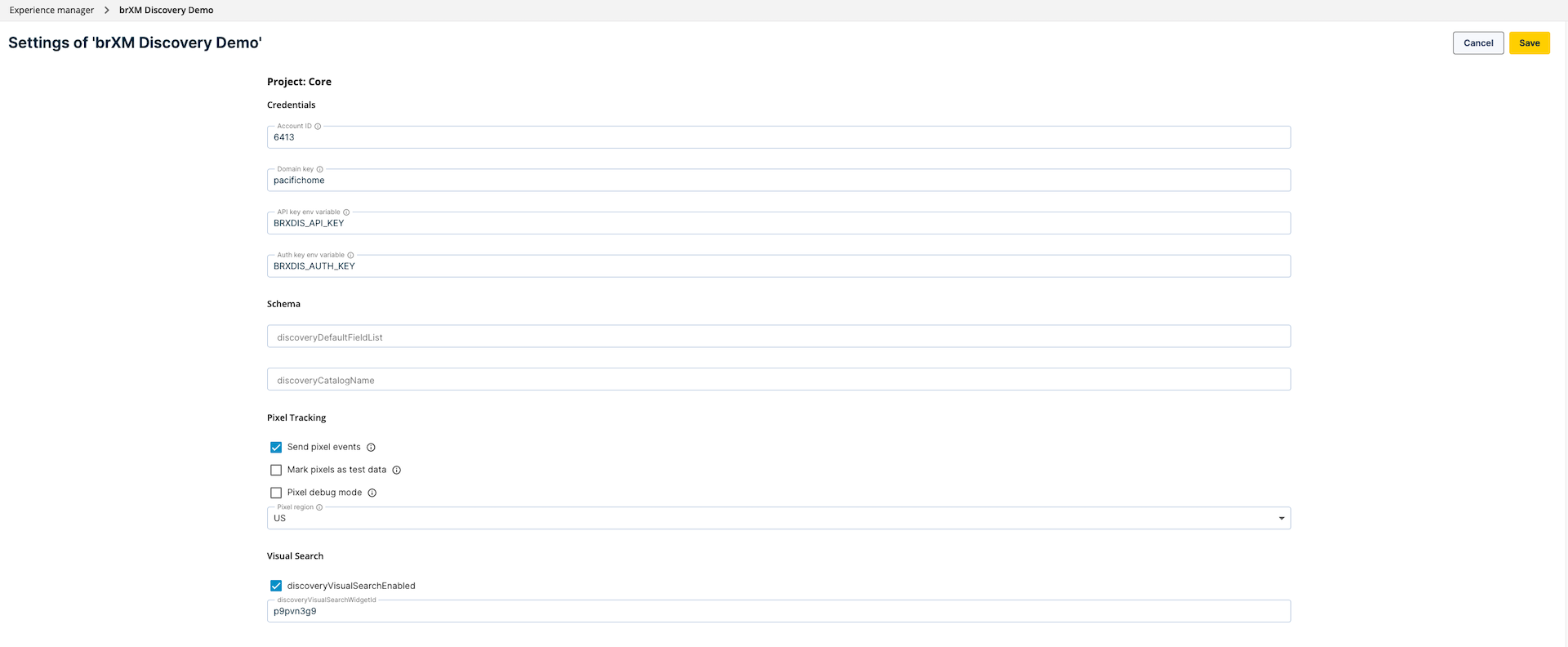
| Group | Properties |
|---|---|
| Credentials | discoveryAccountId, discoveryDomainKey, discoveryApiKeyEnvVar, discoveryAuthKeyEnvVar |
| Schema | discoveryDefaultFieldList, discoveryCatalogName |
| Pixel tracking | discoveryPixelsEnabled, discoveryPixelConsentCookie, discoveryPixelTestData, discoveryPixelDebug, discoveryPixelRegion |
| Visual search | discoveryVisualSearchEnabled, discoveryVisualSearchWidgetId |
discoveryApiKeyEnvVar and discoveryAuthKeyEnvVar are pointers to environment variables, not secrets themselves. This ensures secrets are not stored in JCR, even at the channel level.
/hst:hst/hst:configurations/<your-site>/hst:workspace/hst:channel/hst:channelinfo: jcr:primaryType: hst:channelinfo discoveryAccountId: '7291' discoveryDomainKey: 'petstore-uk' discoveryApiKeyEnvVar: BRXDIS_API_KEY_PETSTORE_UK discoveryDefaultFieldList: 'pid,title,thumb_image,url,price,brand,sale_price,description'
To enable channel-level overrides, set hst:channelinfoclass on the channel node to DiscoveryChannelInfo (or a composite interface that extends your project's existing channel-info type):
/hst:hst/hst:configurations/<your-site>/hst:workspace/hst:channel: jcr:primaryType: hst:channel hst:channelinfoclass: org.bloomreach.forge.discovery.site.component.info.DiscoveryChannelInfo
For details on pixel tracking fields, see Pixel Tracking & Consent. For visual search fields, see Recommendations & Visual Search.
The product field list (fl)
The field list determines which product attributes Discovery returns. These fields are available in ProductSummary.attributes for templates and the Page Model API.
The default field list includes all attributes used by the bundled templates:
pid,title,thumb_image,url,price,brand,sale_price,description
If your catalog includes custom attributes (for example, pet_type, tags), set brxdis:defaultFieldList on the global node or discoveryDefaultFieldList per channel to the complete list you require. The value you set replaces the default; it does not append to it.
Sort options
The sort dropdown in the component editor and the sortOptions key in the Page Model API both use the brxdis:sortOptions property:
brxdis:sortOptions: - 'price asc=Price: Low to High' - 'price desc=Price: High to Low' - 'name asc=Name: A-Z' - 'name desc=Name: Z-A'
Each entry uses the format value=Display label. If this property is not set, the plugin uses the four options shown above as defaults.
Picker field mapping
The CMS picker (used by the Category and Recommendation document pickers and the REST endpoints under ws/discovery/picker/) requires mappings for product ID, title, image, and price fields. These settings are defined only on the global JCR node. There are no environment variable, system property, or per-channel overrides for these properties, as they describe your catalog schema.
| Property | JCR property | Default |
|---|---|---|
| ID field | brxdis:pickerIdField | pid |
| Title field | brxdis:pickerTitleField | title |
| Image field | brxdis:pickerImageField | thumb_image |
| Price field | brxdis:pickerPriceField | price |
/hippo:configuration/hippo:modules/brxm-discovery/hippo:moduleconfig/discoveryConfig: brxdis:pickerIdField: 'pid' brxdis:pickerTitleField: 'title' brxdis:pickerImageField: 'thumb_image' brxdis:pickerPriceField: 'price'
Change these properties only if your feed uses different field names. For example, if your feed uses productName for the title, set brxdis:pickerTitleField: 'productName'. Ensure that any field you set here is also included in the field list (fl), or the picker request will not retrieve it.
Circuit breaker tuning
All outbound Discovery calls use a per-host Resilience4j circuit breaker (CircuitBreakerDiscoveryTransport). This isolates failures or slow responses from one Discovery API (such as recommendations) so they do not affect others (such as search). The circuit breaker opens after a threshold of failures within a sliding window and blocks new calls for a cooldown period before retrying.
These settings are intended for operational tuning and are resolved in this order: environment variable → system property → coded default. They are not available in JCR, as they are meant to be adjusted per deployment environment.
| Setting | Environment variable | System property | Default |
|---|---|---|---|
| Failure rate threshold (%) | BRXDIS_CB_FAILURE_RATE_THRESHOLD | brxdis.cb.failureRateThreshold | 50 |
| Sliding window size (calls) | BRXDIS_CB_SLIDING_WINDOW_SIZE | brxdis.cb.slidingWindowSize | 20 |
| Minimum number of calls | BRXDIS_CB_MINIMUM_NUMBER_OF_CALLS | brxdis.cb.minimumNumberOfCalls | 10 |
| Wait duration in open state (seconds) | BRXDIS_CB_WAIT_DURATION_IN_OPEN_STATE_SECONDS | brxdis.cb.waitDurationInOpenStateSeconds | 30 |
With the default settings: after at least 10 calls in a rolling window of 20, if 50% or more fail, the breaker opens and blocks further calls for 30 seconds before allowing a test call.
mvn -P cargo.run cargo:run \
  -Dbrxdis.cb.failureRateThreshold=40 \
  -Dbrxdis.cb.waitDurationInOpenStateSeconds=60
Verifying configuration
GET http://localhost:8080/cms/ws/discovery/picker/search?q=shirt
You should receive a JSON array of products. If you receive a 404 or an empty error response, review your configuration.
| Symptom | Likely cause |
|---|---|
| ConfigurationException: Discovery accountId is required | Credentials not set; check environment variables |
| Product grid empty, no error shown | accountId or domainKey do not match your Discovery account |
| Custom attribute missing from attributes | Not included in defaultFieldList |
For additional troubleshooting steps and error scenarios, see Troubleshooting.