Relevance Concepts and Terminology
This page defines key concepts and terminology used in the Relevance Module.
Collector
A collector extracts data from each HTTP request and provides it for deriving characteristics, which are then added to the user's targeting data.
For example:
- A collector can detect if a request is a search action and extract the search terms.
- Another collector can check if the request targets a document with defined keywords and extract those keywords.
On every HTTP request, all collectors are invoked to update their data. A collector can specify whether it should update only for new visitors, new visits, or based on existing targeting data.
For a list of available collectors, see Collectors.
Visitor
A visitor is any individual accessing a channel. The Relevance Module assigns each visitor a unique ID stored in a cookie. This ID links HTTP requests from the same visitor. Different devices or browsers used by the same person are treated as separate visitors.
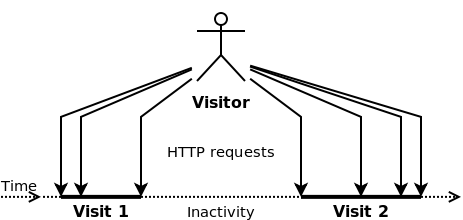
Diagram: The diagram shows a visitor represented by a stick figure at the top. Multiple arrows point downward, each representing an HTTP request. A horizontal time axis at the bottom is divided into two periods, 'Visit 1' and 'Visit 2', separated by an 'Inactivity' interval. Arrows are grouped into the two visit periods, illustrating that requests from the same visitor are grouped into separate visits if there is a gap of inactivity.
Visit
A visit consists of one or more HTTP requests from the same visitor, with each request no more than 30 minutes apart. If a visitor is inactive for more than 30 minutes before making a new request, a new visit begins.
Characteristic
A characteristic is a measurable attribute of a visitor, derived from data provided by a collector. Characteristics are required to use collector data for updating the user's targeting data.
Examples of characteristics:
- City of the visitor
- Device type
Multiple characteristics can be derived from a single collector. For example, the GeoIPCollector provides data for the 'city', 'country', and 'continent' characteristics. Most collectors, however, map to a single characteristic.
For a list of available characteristics, see Characteristics.
Targeting Data
Targeting data is the complete set of information that the Relevance Module stores about each visitor.
Target Group
A target group is a set of name-value properties within a characteristic, defined by a CMS user. Each target group represents a specific value or set of values for a characteristic. For example, within the 'city' characteristic, a target group called 'Big Dutch cities' may include the property names 'Amsterdam', 'Rotterdam', and 'The Hague'.
Target Group Renderer and Editor
Each characteristic interprets the property names and values of its target groups according to its own logic. For example, the 'city' characteristic interprets each property name as a city name. Other characteristics may require specific property names and values.
A characteristic plugin can define:
- A custom renderer to convert target group property names and values into a summary string for display in the UI.
- A custom editor to allow users to edit the property names and values of a target group.
The default renderer displays a comma-separated list of property names. The default editor is a text field where users enter property names separated by commas.
Scorer
A scorer calculates how closely a target group matches the collected targeting data. The score ranges from 0 (no match) to 1 (perfect match).
Example:
- The CityScorer compares a list of city names from the target group to a single city name from the targeting data. It returns 1 if the city matches, otherwise 0.
Some scorers support partial matches and return values between 0 and 1. For example, the VectorScorer compares two lists of N terms and their frequencies, treating them as vectors in N-dimensional space. The score is based on the angle between the vectors, normalized to a value between 0 and 1.
For more details, see Scorers.
Segment
A segment is a group of visitors who share a set of characteristics. A segment is defined by combining multiple target groups. For example, the segment 'Dutch Professional' might combine the target groups 'comes from Big Dutch cities', 'visits the site on a weekday', and 'mostly looks at business category'. The Relevance Module assigns each visitor to the segment that best matches their targeting data.
Persona
A persona is a specific example of a segment, used to preview a channel with personalized components as seen by a visitor in that segment. For example, 'Danielle, the Dutch Professional' could be defined by the properties 'comes from Amsterdam', 'visits the site on Monday', and 'mostly looks at business category'.