Integrations
Integration in Content Management
Bloomreach Content is designed to integrate with existing enterprise architectures. Instead of replacing your current systems, it provides focused digital experience management capabilities and offers integration points to connect with your established solutions. This approach enables you to manage digital experiences and deliver multi-channel content while continuing to use your preferred tools for other business functions.
Content Integration
Content integration is a standard requirement in modern web content management. Enterprise environments often include multiple content-related systems, such as Document Management Systems, Digital Asset Management Systems, E-Commerce Product Catalogs, and Product Information Systems. Legacy content may also be present. Bloomreach Content provides integration points at all stages where content is created, managed, published, processed, or accessed.
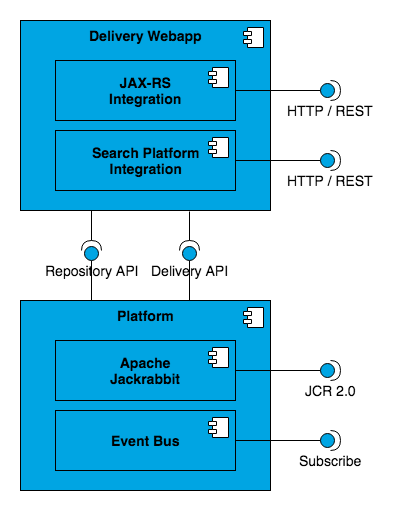
Diagram: This diagram displays two blue containers labeled "Delivery Webapp" and "Platform," each exposing integration points. The Delivery Webapp includes "JAX-RS Integration" and "Search Platform Integration," both connected to "HTTP / REST" endpoints. The Delivery Webapp also connects to the Platform via "Repository API" and "Delivery API." Within the Platform, "Apache Jackrabbit" and "Event Bus" are shown, with connections labeled "JCR 2.0" and "Subscribe," representing repository access and event subscription interfaces.
RESTful Services
The delivery framework supports integration through Java API for RESTful Services (JAX-RS) and Java Architecture for XML Binding (JAXB) standards. These allow you to expose, create, or import content via REST endpoints. This enables scenarios such as Content-as-a-Service (CaaS), where external systems can interact with content over REST.
Search Platform Integration
The delivery framework provides integration points for enterprise search platforms like Solr and Elasticsearch. This allows you to aggregate and deliver content from any source within your enterprise architecture.
Event Bus
The content repository includes an Event Bus, which enables applications to subscribe to workflow events. For example, you can trigger updates to your enterprise search platform when content is published or unpublished.
JCR 2.0 API
The content repository exposes the full JCR 2.0 API, allowing low-level access to content structures. For most integrations, use the higher-level integration points described above.
Data Integration
Relevant content delivery in Bloomreach Content relies on collecting and analyzing visitor data. The platform is designed to integrate with your existing systems, such as CRM, Marketing Automation, and E-Commerce platforms, to leverage customer and lead data.
Relevance Collectors
The primary data integration point is the Relevance Collector interface. Collectors gather data about visitors during site interactions. This data is aggregated into visitor profiles and matched to personas for relevant content delivery.
Collectors can access any data source available during request processing, including external web services. This enables you to enrich visitor profiles with additional data from your enterprise systems, improving relevance and conversion control.
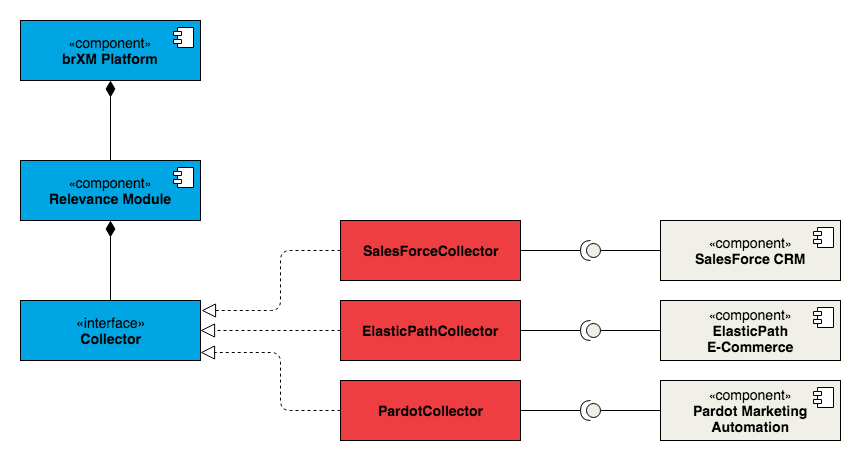
Diagram: This diagram shows the Bloomreach Content Platform connected to a Relevance Module, which links to a Collector interface. The Collector interface connects to three implementations: SalesForceCollector, ElasticPathCollector, and PardotCollector. Each implementation communicates with an external system: SalesForce CRM, ElasticPath E-Commerce, and Pardot Marketing Automation.
REST Endpoint
All visitor data collected by Bloomreach Content is accessible to other applications through a secure RESTful web service. The CMS application uses this interface to render the Experience Optimizer.
Example
For an example of data integration using a relevance collector with the Pardot marketing automation platform, see the Marketing Automation Lab.
Frontend Integration
Web frontend technologies evolve rapidly. Bloomreach Content’s delivery framework is designed to support a wide range of frontend integration scenarios. In addition to native content aggregation and page rendering, it provides integration points for other frontend technologies and frameworks.
RESTful Services
The delivery framework supports Content-as-a-Service (CaaS) delivery through RESTful services, enabling integration with any frontend technology or framework.
You can use any frontend architecture—such as Single-Page Applications, server-side rendered applications, or native mobile apps—to access content delivery features via REST. You control how content is aggregated and rendered, whether server-side, client-side, or in a hybrid approach.
This flexibility allows you to use your organization’s existing frontend stack and expertise while leveraging the capabilities of Bloomreach Content’s delivery framework.
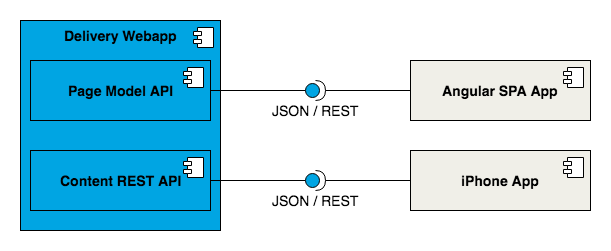
Diagram: The diagram shows a Delivery Webapp container with two internal APIs: Page Model API and Content REST API. Each API connects via a JSON / REST interface to a client application: the Page Model API to an Angular SPA App, and the Content REST API to an iPhone App. This illustrates how external applications consume Bloomreach delivery services through RESTful JSON interfaces.
Container Level Integration
The delivery framework supports container level integration with most Java-based web application frameworks, including Spring Web MVC, Struts, Tiles, Wicket, and basic servlets. This integration enables you to use features such as URL-content mappings, content beans, link rewriting, session pooling, and the query API, while delegating content aggregation and page rendering to your chosen framework.
Container level integration is suitable for hybrid solutions where Bloomreach Content provides specific parts of larger, aggregated web pages.