Scalability
Bloomreach Content is built to support scaling for a wide range of traffic demands. Its architecture enables you to adjust capacity as requirements change over time.
Horizontal Scalability
Bloomreach Content supports horizontal scaling at the system architecture level. You can scale each of the three primary tiers independently:
- Web tier: Deploy a load balancer with multiple web servers acting as reverse proxies.
- Application tier: Cluster any number of application servers. Authoring and delivery applications are separated, so you can cluster each independently.
- Database tier: Use a single database server, a cluster of servers, or a primary/replica configuration.
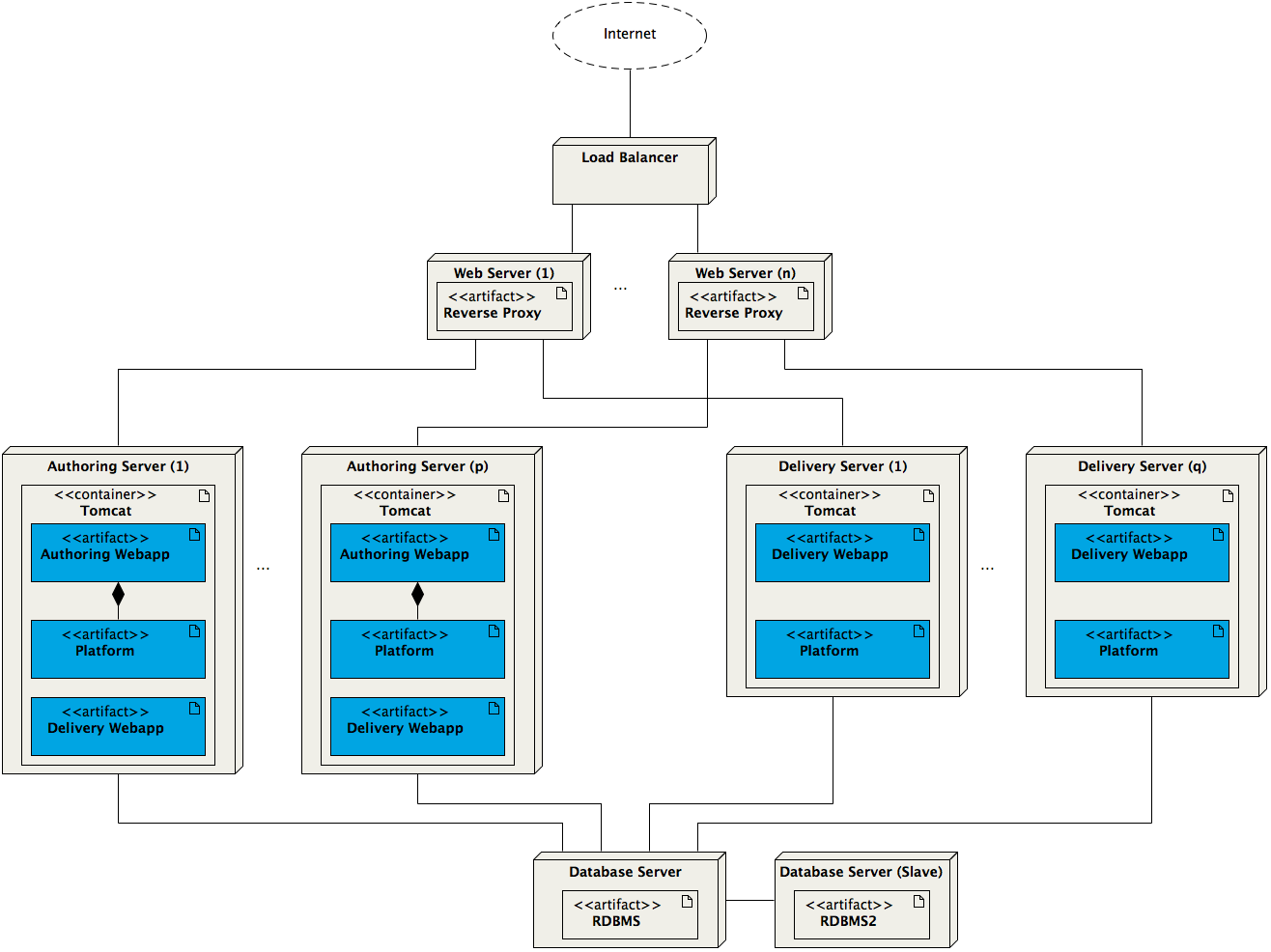
Diagram: This diagram illustrates a clustered Bloomreach Content deployment. Traffic flows from the Internet through a load balancer to multiple web servers (reverse proxies). These proxies direct requests to separate groups of authoring servers and delivery servers. Each group can contain multiple instances.
Authoring servers run Tomcat containers with the Authoring Webapp, Platform, and Delivery Webapp. Delivery servers run Tomcat with the Delivery Webapp and Platform. All application servers connect to a primary database server (RDBMS), which is replicated to a secondary database server (RDBMS2) as a slave.
A Bloomreach Content application cluster uses a journal table in the database to synchronize content repositories across nodes. When you add a new node, it automatically synchronizes with the cluster. This approach allows you to respond quickly to changes in traffic by adding or removing nodes as needed.
For the authoring webapp, configure the load balancer to support sticky sessions. The delivery webapp typically does not require sticky sessions if you follow recommended practices, but you can configure this based on your implementation.
Vertical Scalability
Bloomreach Content’s delivery framework also supports vertical scaling. By efficiently using hardware resources and implementing effective caching strategies, the system can handle more concurrent requests as you increase CPU speed or add CPU cores. This linear scaling is especially effective in virtualized environments, providing another way to adjust to changing traffic demands.
Note: Bloomreach Content must connect only to the active or primary database.